

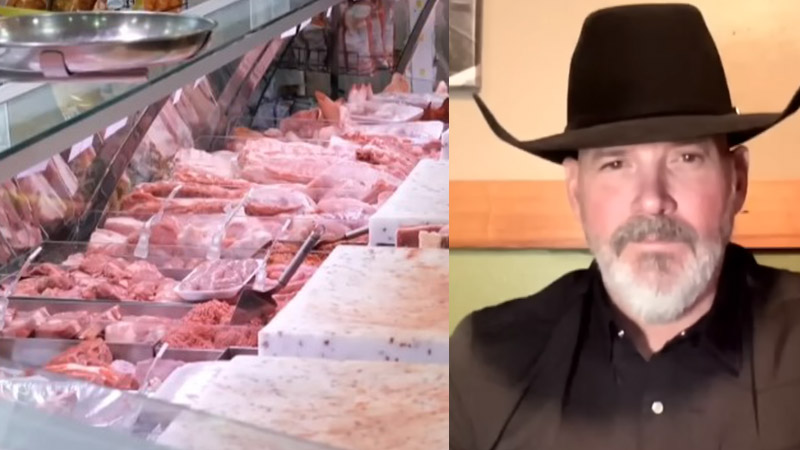
NTD News host Tiffany Meier opened a recent interview with a line that sounded deliberately like a campaign slogan: “Make beef affordable again.” According to Meier, that phrase is now circulating inside the White House Office of Trade and Manufacturing and reflects growing concern about consolidation in the U.S. meat industry.
Meier pointed to Peter Navarro, who recently posted on X that Donald Trump is “going after” four major meat packers, Cargill, JBS, Tyson, and National Beef, labeling them the “big beef cartel.” Navarro also expanded the argument in a Washington Examiner op-ed titled Inflation Didn’t Eat Your Steak, a Cartel Did.
Meier added that Tim Burchett has sent a letter to Pam Bondi, backing what she described as a Justice Department antitrust investigation into foreign-owned meatpacking companies, many of which have ties to Brazil and China.
To translate the politics into real-world impact, Meier spoke with Steve Lucie, a fifth-generation cattle rancher. Lucie quickly stripped away the slogans and described a market reality that he says leaves ranchers with little leverage.
Unless he sells directly to local customers, Lucie explained, his cattle almost inevitably pass through one of the “big four.” Once those companies control the processing, they decide what boxed beef sells for at grocery stores and restaurants. From his perspective, that’s where the “cartel” language comes from.
Lucie said the largest packers control roughly 85% of beef processing. With that level of concentration, ranchers have few alternatives and little negotiating power. Consumers, he added, often assume high grocery prices mean farmers are thriving, when in reality producers may be getting squeezed.
He offered a specific example from October, when President Trump’s comments about potential beef imports from Brazil and Argentina rattled the market. Lucie said live cattle prices dropped from about $2.40 a pound to roughly $2.10 within weeks. At the same time, he claimed boxed beef prices “went up and up” at the store.
Lucie described packers using “a little blurb from the president” to their advantage, arguing that companies with this much control can throttle processing, adjust output, or even close plants temporarily to influence prices.
He stressed that cattle producers cannot simply wait out bad prices. Animals keep eating, costs keep accumulating, and ranchers cannot pause production indefinitely. That imbalance, he said, gives packers outsized power over both ends of the supply chain.
Lucie acknowledged that buying directly from ranchers can lower costs. He told Meier that ribeye steaks that sell for $18 to $20 a pound in stores could average around $6.50 a pound when purchased directly from a half beef, after processing. Still, he cautioned that regulations and a shortage of local processors make that option impractical for most Americans.
On foreign ownership, Lucie said the influence of Brazil and China is “tremendous.” He noted JBS is Brazilian-owned and the largest meatpacker in the U.S., while Brazil is the world’s biggest beef exporter and China its largest importer. Combined with a historically low U.S. cattle herd, Lucie warned the system lacks resilience.
Asked what would lower grocery prices, Lucie pointed to supply, demand, and stability. Ranchers, he said, need steady prices to justify expanding herds, while consumers need fair costs. That balance, he argued, requires a market that is “free and open,” without manipulation — a goal now at the center of renewed antitrust scrutiny.
READ NEXT
- Florida mom busted for DUI after cops spot 5-year-old dangling out car window
- Miley Cyrus opens up about final conversation with godmother Dolly Parton before her death
- Indiana woman sentenced to 33 years for killing 17-month-old who wouldn’t stop crying
- Scott and Kelley Wolf confirm divorce after months of family healing
- Toddler found wandering Marietta streets after caregiver allegedly took 2 hours to raise alarm