

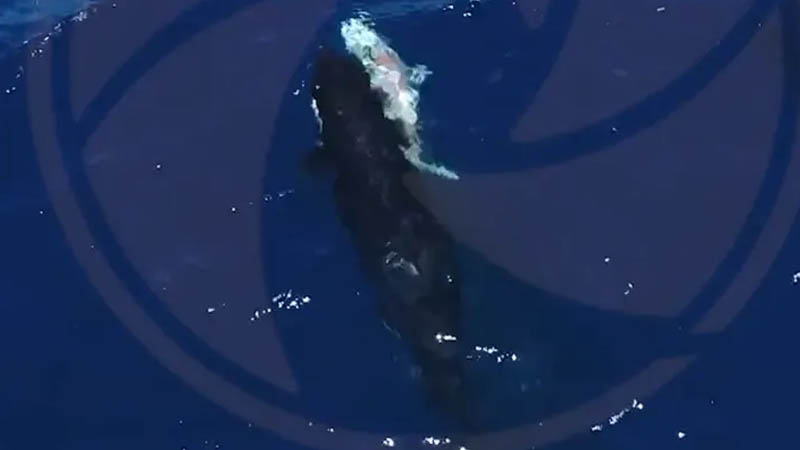
Killer whales have been caught on camera hunting and eating great white sharks alive, flipping them upside down to paralyze them before tearing out their energy-rich livers. The newly documented behavior, reported by Frontiers in Marine Science, shows just how intelligent and strategic these orcas can be.
A group known as “Moctezuma’s Pod” appears to have perfected the gruesome technique. Researchers say the pod may be targeting young sharks as their nursery zones shift due to warming waters in the Gulf of California. Marine biologist Erick Higuera Rivas, who led the study, told Frontiers in Marine Science that orcas might hunt white sharks far more often than previously believed.
“This behavior is a testament to orcas’ advanced intelligence, strategic thinking, and sophisticated social learning, as the hunting techniques are passed down through generations within their pods,” he said.

Scientists observed two separate hunts that ended with three sharks killed. The team was able to track the orcas by their dorsal fins and capture rare footage of the attacks.
In August 2020, five orcas chased a young great white, forcing it to the surface and flipping it onto its back. They dragged it underwater, then resurfaced carrying its liver in their mouths. Minutes later, they killed another shark using the same brutal method.
Two years later, in August 2022, the researchers witnessed nearly identical behavior. Another group of five orcas pushed a juvenile shark onto its back, leaving it bleeding from its gills as they devoured its liver.
The trick lies in a phenomenon called “tonic immobility,” which paralyzes sharks when they’re turned upside down. “This temporary state renders the shark defenceless,” explained Higuera Rivas. The orcas then feast on the most nutrient-dense parts of the shark, leaving the rest of the body behind. The study suggests the predators may have developed a specialized way of shocking their prey before killing it, making smaller and younger great whites easier targets.
Dr. Salvador Jorgensen, a co-author from California State University, said that older sharks tend to flee an area for months after orcas appear. But younger sharks may not yet know how to respond. “We just don’t know yet whether white shark anti-predator flight responses are instinctual or need to be learned,” he said.
Moctezuma’s Pod isn’t new to this kind of hunting. Researchers have seen the group take on rays, whale sharks, and bull sharks before. That experience might have helped them figure out how to handle great whites.
Climate change could also be playing a role. Shifts in ocean temperature, including recent El Niño events, have likely moved white shark nursery areas closer to where the orcas hunt. Those changes may have placed the young sharks directly in the path of one of the ocean’s most efficient killers.
The findings give scientists a chilling new look at just how adaptable and intelligent orcas are—and show that even great white sharks aren’t safe from these apex predators.