

Federal workers across the country are finding themselves in food lines, and Pastor Oliver Carter is one of them. From his small church, No Limits Outreach Ministries, just outside Washington, DC, he’s been running a food bank to help struggling families for years. Now, because of Trump’s government shutdown, his own family has joined those depending on the charity to eat.
Carter’s wife, Pamelia, works for the US Department of Agriculture. She’s among more than 700,000 federal employees furloughed since October 1, forced into unpaid leave until the government reopens. Her last paycheck was half of what she normally earns, and the most recent one was nothing. “Thank God for the food bank,” Carter says, glancing at the pile of unpaid bills on his desk. “Because that’s one thing we don’t have to worry about.”
Also Read: Federal Workers’ Union Urges Congress to Act
Outside his Hyattsville church, hundreds of federal workers wait in the brisk 40-degree morning air, bundled in coats and holding folding chairs. They arrive hours early, hoping to get one of the limited frozen meat packages before supplies run out. The rest will go home with peanut butter, canned goods, and tuna pouches.
One woman from the Department of Health and Human Services says she’s been applying for second jobs to cover her daughter’s tuition and care for her elderly mother. She’d also apply for food stamps, but starting Saturday, that program will have no funds left.
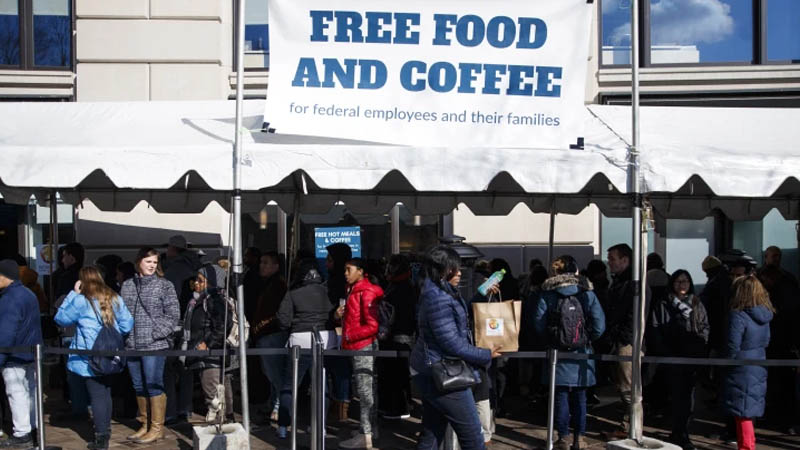
This is happening nationwide. With Trump’s shutdown halting paychecks and the Supplemental Nutrition Assistance Program, or SNAP, set to run out of money, millions of Americans face food insecurity. Normally, the government would use emergency funds to keep SNAP going, but the Trump administration announced it won’t.
More than 20 states have sued, arguing that refusing to use those funds is illegal. A few, like Virginia and New Mexico, have pledged temporary help, but for most of the 42 million Americans who rely on SNAP—including 14 million children and 1.2 million veterans—the aid is running out fast.
Read More: Government Shutdown Hits U.S. Economy as Bank of America CEO Warns of Slower Growth
As more families look for help, food banks are running dry. “There’s absolutely more need, but less food,” Carter says from his cramped office. “It’s bad.”
Meanwhile, nonprofit leaders and policymakers are meeting at George Washington University to discuss the growing crisis. Alexander Moore, chief development officer at DC Central Kitchen, says nonprofits like his are already stretched to the limit. His organization serves 17,000 meals every day. “It’s hard to fathom this severe a blow to food security,” Moore says, adding that the situation feels as dire as the start of the pandemic.
More: New York Bills Seek to Protect Federal Workers from the Impact of Shutdowns
The problem has been building for months. Earlier this year, the Trump administration canceled $500 million in food shipments from the Emergency Food Assistance Program, cutting 780,000 meals from the DC area alone. Another $1 billion program that allowed food banks to buy from local farmers was also eliminated. USDA Secretary Brooke Rollins told Fox News that the program “was an effort by the left to continue spending taxpayer dollars that were not necessary,” reported by MSNBC.
Still, Carter remains determined. He’s been reaching out to grocery stores and local farmers for donations and recently received six frozen turkeys. It’s not much, but he’s grateful. With the holidays approaching, he knows the lines at his food bank will only grow—and that one of the families waiting will be his own.