

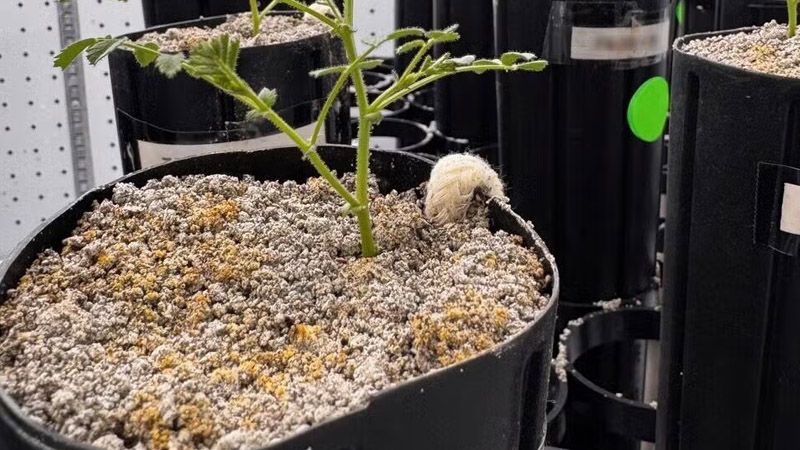
A pot filled with gray, lifeless regolith might not look like the beginning of a meal. But in a new scientific experiment, researchers have managed to grow chickpeas all the way to seed production using material designed to mimic lunar soil. The result offers an early glimpse into how astronauts on future moon missions might eventually grow their own food.
The research was led by scientists from The University of Texas at Austin and Texas A&M University. Their goal was to test whether chickpeas could grow in simulated lunar regolith when mixed with vermicompost, a nutrient-rich organic material created by red wiggler earthworms. The team also introduced arbuscular mycorrhizal fungi, organisms that form beneficial relationships with plant roots and help them tolerate environmental stress.
The experiment produced a promising result. Chickpea plants grown in mixtures containing up to 75% simulated lunar regolith produced harvestable seeds. Plants grown in pure regolith did not survive long enough to produce seeds, though those treated with fungi survived about two weeks longer than plants without the fungal support.
Lunar regolith, often referred to as moon dirt, differs significantly from Earth’s soil. It contains no organic matter or microorganisms and has poor structure for retaining water and air. Although it includes minerals plants require, such as phosphorus, potassium, calcium, magnesium, and iron, many of these nutrients exist in forms that plants cannot easily absorb.

The material can also present risks. Metals, including iron, aluminum, zinc, and copper, can accumulate to toxic levels for plants, while nitrogen, another essential nutrient, is extremely limited. Researchers, therefore, asked whether the regolith could be gradually converted into a more suitable substrate for plant growth.
“The research is about understanding the viability of growing crops on the moon,” said Sara Santos, the project’s principal investigator and a distinguished postdoctoral fellow at the University of Texas Institute for Geophysics. “How do we transform this regolith into soil? What kinds of natural mechanisms can cause this conversion?”
Chickpeas were selected carefully for the experiment. The legume is rich in protein, carbohydrates, iron, phosphorus, calcium, and vitamin B, while also requiring relatively little water or nitrogen. It can also host the beneficial fungi used in the study.
Although seeds germinated successfully even in 100% regolith, problems arose as the plants matured. Some showed stunted growth, yellowing leaves, and reduced branching. However, plants treated with fungi performed noticeably better and survived longer under difficult conditions.
Only fungus-treated plants grown in 25 percent, 50 percent, and 75 percent regolith mixtures produced flowers and seeds. They also matured more slowly, taking about 120 days compared with 100 days for plants grown in regular potting soil.

“We want to understand their feasibility as a food source,” said Jessica Atkin, the study’s lead author. “How healthy are they? Do they have the nutrients astronauts need? If they aren’t safe to eat, how many generations until they are?”
The experiment still leaves many questions unanswered. Scientists must determine whether the chickpeas are safe for human consumption, how much metal is accumulated in the seeds, and whether the crop could fully meet astronauts’ nutritional needs.
Still, the findings suggest that future lunar farming may rely on gradually improving the moon’s soil through biological processes. By mixing regolith with recycled organic waste and beneficial fungi, astronauts might one day grow part of their food supply while recycling mission waste into usable growing material. Research findings are available online in the journal Scientific Reports.
READ NEXT
- Nicole Kidman and Keith Urban’s daughter Sunday Rose opens up about modelling with famous parents
- Louisiana mom blamed toddler’s bruises on “sleeping with her sippy cup,” police say
- Alina Habba calls report on $50 million deal a “Big Scoop”
- Kim Kardashian reportedly fears Christmas conflict with Kanye West over Lewis Hamilton
- Ohio mother charged after toddler’s death, told 911 “we’re past that” and fled