

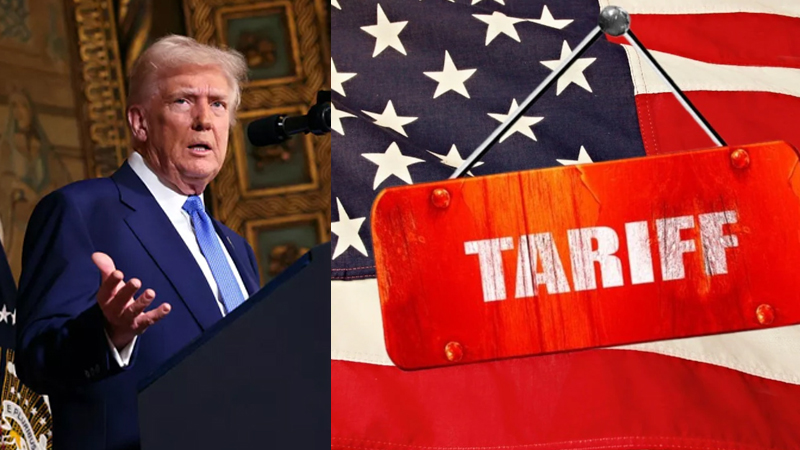
New figures from the US Treasury Department show that tariff revenues fell again in December, raising fresh questions about the long-term impact of President Trump’s sweeping trade strategy. According to the Treasury’s Monthly Treasury Statement released Tuesday, the US collected $27.89 billion in tariff revenue in December. That brought total collections for 2025 to $264.05 billion, the highest annual figure on record.
But December also marked the second consecutive monthly decline after Trump scaled back several key tariffs in November. Revenue peaked in October at $31.35 billion before slipping to $30.76 billion in November. The December figure represents a drop of more than 10% from the October high. Economists say the decline reflects how tariffs are reshaping global trade flows and reducing the volume of goods entering US ports.
Commerce Department data points in the same direction. The US trade deficit narrowed to $29.4 billion in November, the lowest level since mid-2009. The report was delayed by last fall’s government shutdown, but analysts say the trend reflects weaker trade activity tied to the administration’s tariff program.
The scale of change over the past year is striking. In December 2024, the US collected just $6.81 billion in tariffs. For all of 2024, total tariff revenue stood at about $79 billion. The jump to more than $264 billion in 2025 underscores how aggressively trade policy has shifted.
Even so, the new Treasury data also showed that the federal deficit continues to dwarf tariff income. The US ran a deficit of $602 billion between October and December, including a $145 billion shortfall in December alone. That gap persists despite Trump’s frequent claims that tariffs are helping balance the budget.
The president has not softened his rhetoric. Speaking in Detroit shortly after the report’s release, Trump again praised tariffs, saying they are generating “hundreds of billions coming into the US Treasury.” He has argued in recent months that tariffs could fund a wide range of priorities, including a proposed $500 billion increase in the military budget, a figure that exceeds the entire tariff revenue collected in 2025.
Budget analysts remain skeptical. The Congressional Budget Office recently cut its projected tariff revenue for the next decade by $1 trillion, citing expectations of reduced trade volumes and policy changes. Trade uncertainty also continues into 2026. Trump this week threatened new 25% tariffs on goods from any nation “doing business” with Iran.
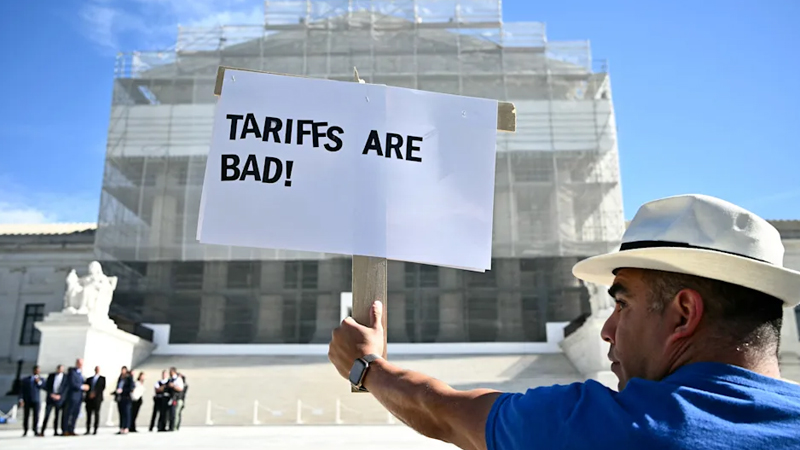
At the same time, the Supreme Court is expected to rule soon on the legality of Trump’s “blanket” tariffs. In Detroit, the president warned that an adverse ruling would hurt the country, saying, “we have a group that’s foreign-centric, China-centric,” and adding, “we’ll figure something out.”
Shipping data highlights the broader impact. A January report from Project44 found that in 2025, US imports from China fell 28% while exports to China dropped 38%, calling the shift “one of the sharpest bilateral trade contractions in recent history.”
While US trade slows, other regions are moving in the opposite direction. The European Union recently backed a major trade deal with Mercosur, a bloc of Latin American nations that together represent more than 700 million people, signaling that global trade may be evolving without the US at its center.
READ NEXT
- Nicole Kidman and Keith Urban’s daughter Sunday Rose opens up about modelling with famous parents
- Louisiana mom blamed toddler’s bruises on “sleeping with her sippy cup,” police say
- Alina Habba calls report on $50 million deal a “Big Scoop”
- Kim Kardashian reportedly fears Christmas conflict with Kanye West over Lewis Hamilton
- Ohio mother charged after toddler’s death, told 911 “we’re past that” and fled