

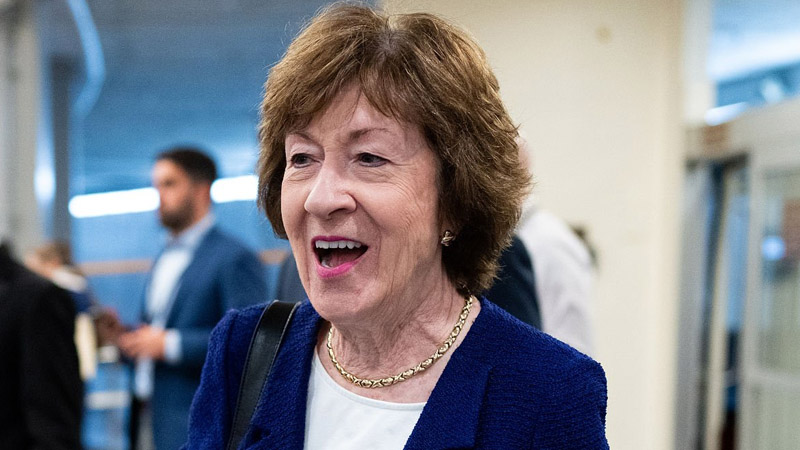
Sen. Susan Collins (R-ME) was confronted by reporters on Tuesday about her vote to confirm Supreme Court Justice Brett Kavanaugh, given his subsequent role in overturning nationwide abortion rights, and stood firmly behind her decision.
A reporter from News Center Maine asked Collins about the vote during her first reelection campaign since the Supreme Court overturned Roe v. Wade. “I was hoping you could talk to me a little bit about your vote to confirm Kavanaugh and whether you regret that?” the reporter asked.
“I do not regret that vote,” Collins responded. “I do disagree with Justice Kavanaugh’s vote. I would point out that in that decision, several Supreme Court justices whom I supported voted the other way. That includes Justice Sotomayor, Justice Elena Kagan, Justice Jackson. So I have supported a great number of Supreme Court justices.”
She went on to explain her broader approach to evaluating nominees. “When I look at a justice, I look at their qualifications, their integrity, their background, their experience in reaching a decision,” Collins said. “Obviously I’m disappointed in that decision, which turned abortion issues back to the states. It has not had an impact on the state of Maine, in that Maine actually expanded its law.”
Collins’s comments come as she faces a closely watched reelection battle in Maine. Democrats have nominated Graham Platner, an oyster farmer and harbormaster, who has been campaigning on a progressive platform while also fielding questions about past controversies.
Collins’s vote to confirm Kavanaugh in 2018 was among the most contentious of her Senate career, coming amid allegations of sexual misconduct against the nominee and intense pressure from both parties. Her support helped secure his confirmation by a narrow margin of 50-48. Kavanaugh later joined the majority opinion in Dobbs v. Jackson Women’s Health Organization, the 2022 ruling that overturned Roe v. Wade and returned abortion policy to individual states.
By contrast, Collins noted that several justices she also voted to confirm, including Sonia Sotomayor and Elena Kagan, dissented from that decision. Ketanji Brown Jackson, who joined the Court after Roe was overturned, was not part of the Dobbs ruling but has since been confirmed with Collins’s support.
The senator’s remarks reflect a defense she has offered before: that her judicial philosophy prioritizes a nominee’s qualifications and judicial temperament over predicting how they might rule on any single issue. Critics, however, have pointed to her past assurances that Kavanaugh respected precedent as evidence that her judgment on the nomination was mistaken.