


Farmers in the United States had a momentary sense of comfort in 2025 due to the availability of soybeans; nevertheless, the picture for 2026 is becoming more dubious. A large number of manufacturers are now facing the possibility of new pricing pressure due to global oversupply and severe competition from South America. This comes after years of narrow profit margins and growing input prices.
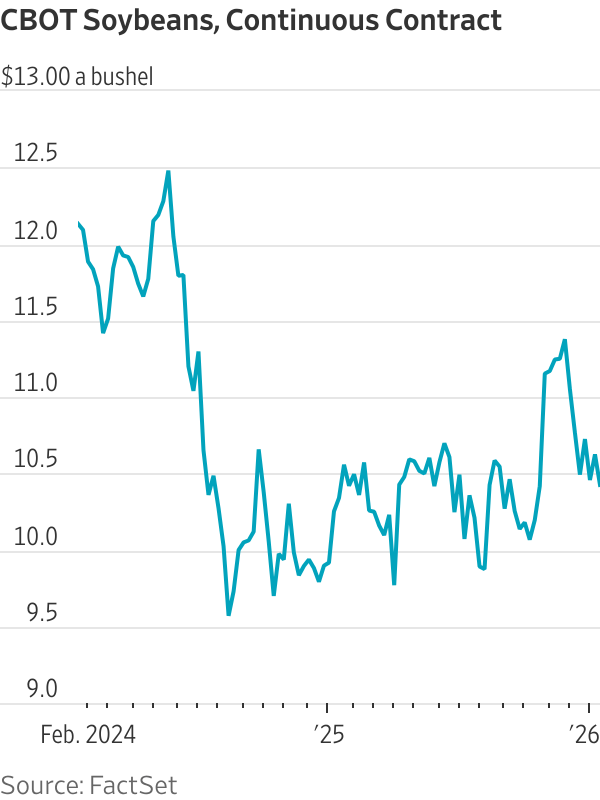
When soybean futures saw a strong increase at the end of the previous year, farmers had cause to be cautiously optimistic. Following China’s agreement to acquire around 12 million metric tons of soybeans from the United States, prices on the Chicago Board of Trade hit their highest level in 16 months, near $12 per bushel, in November.
According to The Wall Street Journal, the surge, which outpaced both maize and wheat futures, initially fueled expectations that soybeans could become a more profitable alternative for planting. That optimism has since faded. On Wednesday, the most active soybean contract settled at $10.43 a bushel, about 10% below its August high. The decline is significant for producers who are currently operating at or near their break-even point.
“For a grains producer, there is no place to run and no place to hide,” said Don Roose, the chairman of the brokerage firm U.S. Commodities, which is located in West Des Moines, Iowa. Production levels remain high. According to the most recent World Agricultural Supply and Demand Estimates report published by the United States Department of Agriculture, farmers in the United States harvested an average of 53 bushels per acre in the previous year, a record high.

On the other hand, exports have not kept up. Compared with the previous year, farmers sold around 16% fewer soybeans overseas, leaving more beans in storage bins after harvest. In the latter part of the year, China’s increased purchases helped stabilize the market; nevertheless, many experts believe this demand is only temporary.
As a result of prior trade conflicts, China was forced to obtain additional soybeans from Brazil and Argentina. Furthermore, in November, purchasers returned to the United States markets. Even so, there are still concerns about what will happen if Brazilian exports begin to increase. According to Roose, “We are aware that beginning in February, our export rate for soybeans will gradually decrease until it reaches zero.”
At this very moment, Brazil is starting its harvest, and the figures are intimidating for producers in the United States. This season, the United States Department of Agriculture anticipates that Brazil will export a record 178 million metric tons of soybeans. Michael Cordonnier, the CEO of Soybean & Corn Advisor Inc., said that early yields are good and that they have collected only about 1% of the crop.
This amount poses a risk of flooding global markets, leading to prices falling even further. “It is difficult to see how farmers are going to make any money at these prices, and I do not see any reason for the prices to increase given the crop conditions in South America,” Cordonnier said. “It is challenging to see how farmers are going to make any money.”
Many farmers in the United States may yet expand their soybean acreage this spring, despite the very difficult price situation. This is mostly because soybeans are less expensive to cultivate than corn. A greater amount of fertilizer is required for corn production, and the market for maize is experiencing its own supply glut as a result of farmers producing more than 17 billion bushels of corn in the previous year.
Many farmers still do not make a profit from either crop. As of the beginning of this year, the prices of maize and soybeans are “significantly below break-even prices” for farmers, according to Scott Metzger, who is the president of the American Soybean Association. He continued, “It does not appear to be a good sign for the following year.”
Despite the fact that some farmers depend on $12 billion in USDA assistance payments to keep afloat, many others consider this a short-term solution. According to Tom Halverson, the Chief Executive Officer of CoBank, “I don’t think anyone realistically expects that costs are going to come down in any sort of major degree.”
READ NEXT
- Years before taking office Trump said again and again that Obama would bomb Iran to win the election
- Marjorie Taylor Greene blasts Trump administration saying ‘We voted for America First and ZERO wars’
- New data shows even loyal MAGA Republicans now questioning their Trump support
- Legal analyst says ‘Melania is an interesting one’ as Clinton testimony could open door to Trump questions
- Family discovers massive 20 million year old whale fossil after spotting bones in the sand on a beach